In this patent an insole consists of two things: a soft base shape covering the whole sole, and a stiff component that sits on it only in certain places. The entire inventive idea lies in the shape of that stiff component.
What is the actual invention?
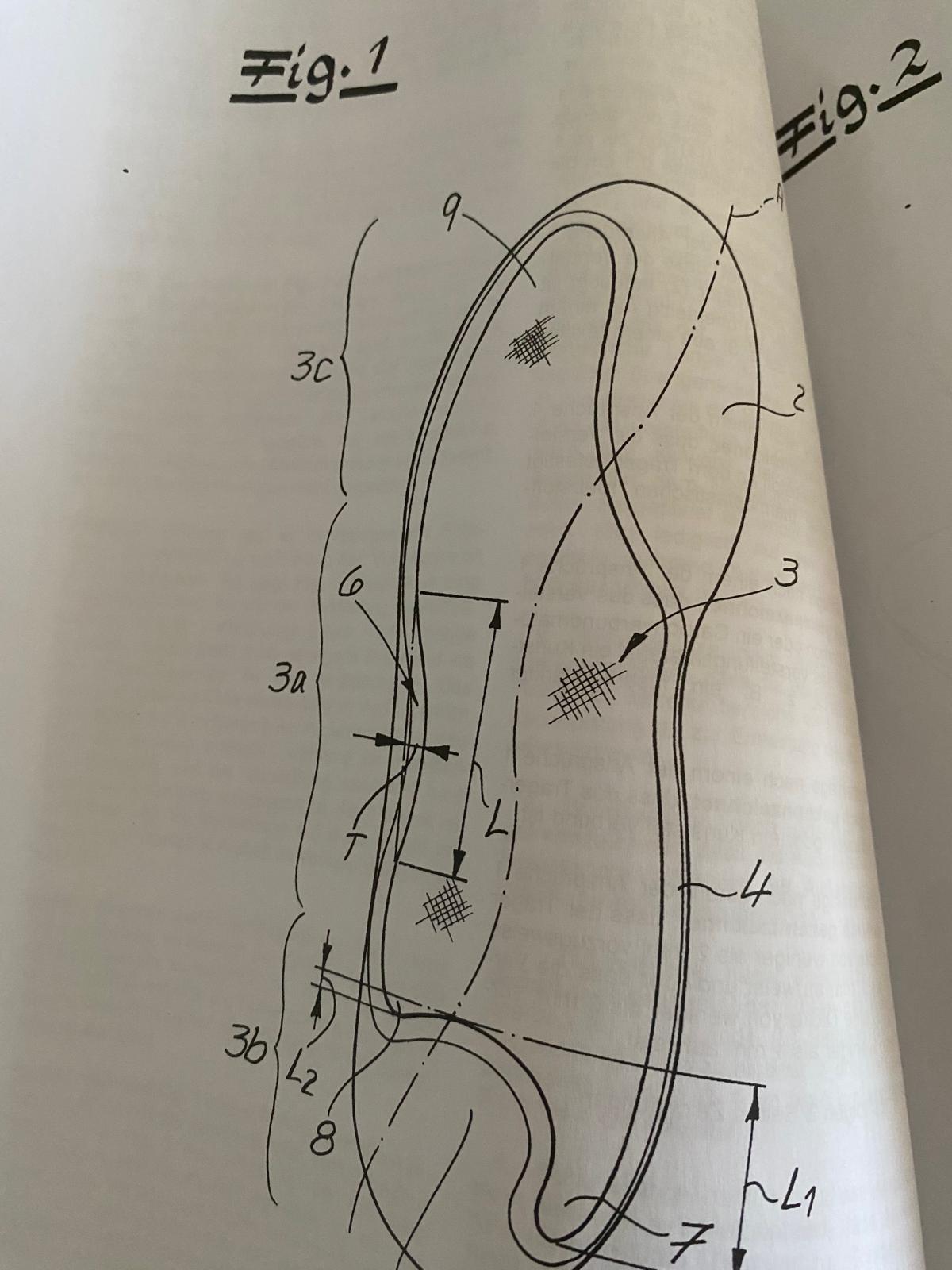
The patent describes a shoe insert with a carrier — the sole-shaped base — and a stiffening connected to it. It is not new that an insole is stiffened. What is new is how this stiffening is cut.
The stiffening covers less area than the carrier and is divided into three zones: forefoot, midfoot and rearfoot. At the rearfoot it does not run as a closed cup but as a clasp with two legs — inner and outer — and an open recess in between, the heel recess.
Two details are named by the patent as the new part: the inner leg is longer than the outer one. And in the forefoot the stiffening continues only on the outside — as a narrow tongue — while there is no stiffening material on the inside.
Why is carbon not simply patented?
Because the specification does not claim a specific material. It refers only to a “carrier material” and a “stiffening material” — without defining what they consist of. A material such as carbon has also been known for decades; known materials as such can no longer be patented.
What can be protected is therefore not the material but the concrete design solution: which area the stiffening occupies, how it is opened at the rearfoot and how it tapers off at the forefoot.
Why is geometry the decisive factor?
The characterising part of the main claim — exactly the part that distinguishes the patent from prior art — consists solely of geometric statements: different lengths of the two clasp legs (L1 greater than L2) and a tongue-shaped forefoot area, reduced in width, running only laterally.
In other words: two insoles made from the same material can be in entirely different IP situations — what matters is how the stiffening is cut.
How does the construction differ?
| Feature | Described in the patent |
|---|---|
| Area of the stiffening | Smaller than the carrier area — i.e. not full-surface. |
| Rearfoot | Clasp-shaped with medial and lateral leg and a heel recess in between. |
| Leg lengths | Different: the medial leg is longer than the lateral one. |
| Forefoot | Tongue-shaped, narrower than the midfoot area, lateral only — recessed medially. |
| Material | Not specified — generally “carrier material” and “stiffening material”. |