Knee pain on the road bike – an honest diagnostic guide
TL;DR
- 1. Check saddle height and cleats first – otherwise no insole will help.
- 2. If pain persists: a carbon insole stabilises the foot axis and relieves the knee.
- 3. Entry = Comfort (109 €). Immediate help with real carbon shell = Performance (139 €). For prescriptions/asymmetries = Customized (199 €, often at Performance level with prescription).
Check saddle height – the most common cause
Pain at the back of the knee almost always indicates a saddle that's too high. Pain at the front below the kneecap often points to a saddle that's too low or cleats positioned too far forward. Even 3 mm of saddle-height difference can noticeably change the knee load angle – before you even consider an insole.
- Pain at the back of the knee → try lowering the saddle 3–5 mm.
- Pain in front of the kneecap → raise the saddle 3–5 mm or move cleats 2–3 mm rearward.
- Lateral pain (inside/outside) → usually foot axis / pronation – see step 3.
Cleat position – the underrated knee killer
If your cleats sit crooked, you force the foot into rotation with every pedal stroke. The shear force absorbed by the knee is enormous – even a perfect insole can't compensate for this, because the problem is at the shoe-pedal interface, not the foot.
Rule of thumb: the cleat centre sits under the ball of the big toe; cleat rotation is neutral or minimally outward (5–7°), never inward.
Unsure about saddle height or cleats? Our bikefitting partner Machacek Fahrradbiometrie combines measurement and Winsole adjustment in a single session.
View bikefittingFoot axis – this is where the insole becomes relevant
If you've worked through saddle and cleats and pain remains – usually on the side of the knee – there's a high chance your foot collapses inward under load (pronation). This forces the knee into a knock-knee pattern that creates micro-strain on cartilage and tendons with every pedal stroke.
What a carbon insole actually does
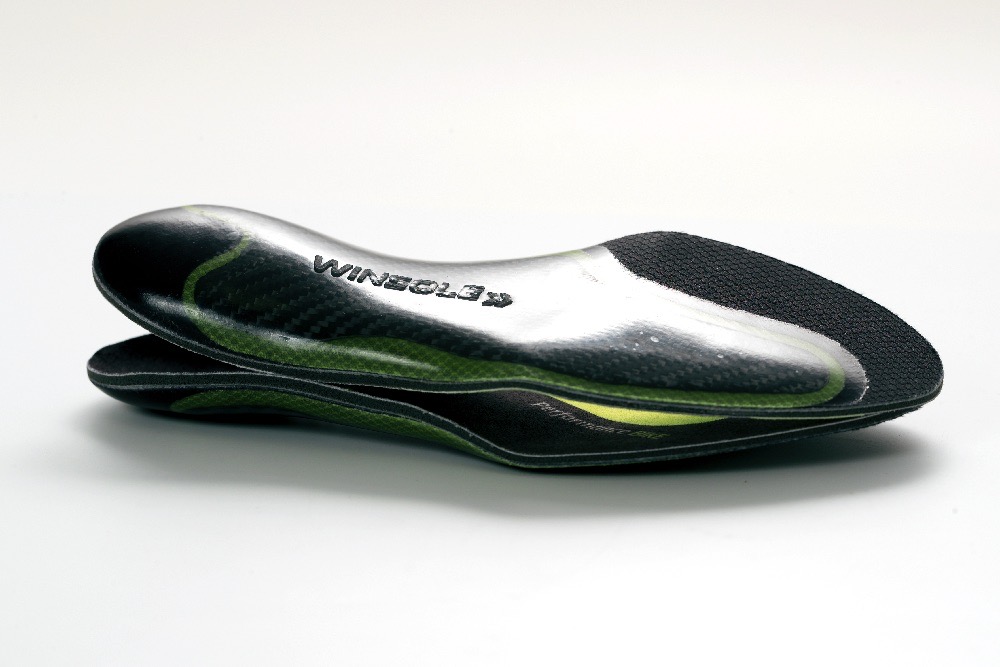
The extremely stiff carbon shell prevents the foot from rotating or collapsing during the downstroke. When the foundation is stable, the knee's lateral wobble disappears – and with it, the cause of lateral knee pain.
Which Winsole for knee pain?
Honestly by use case, not by margin.
Winsole Comfort · 109 €
Stabilising insole for entry-level riders and occasional complaints. Ships immediately – the honest option if you first want to test whether a supportive insole relieves your knee.
View ComfortWinsole Performance · 139 €
Ultra-thin carbon shell, ships immediately. Fully stabilises the foot axis in roughly 80 % of standard pronation cases – the fastest way to relieve the knee.
View PerformanceWinsole Customized · 199 €
Custom-made via foam impression. With a statutory or private prescription, many insurers reimburse a large share – your out-of-pocket cost is then often at Performance level or below. Useful for recurring complaints, asymmetries or medical prescription.
View CustomizedNot sure which variant? Our 60-second consultation quiz gives you a clear recommendation.
Start consultation quizWhat does the science say? – The 44 watts honestly explained
The +44 W measured at FES Berlin is a laboratory-documented peak value under extreme conditions (track cycling national team, 1000+ W sprints). For a hobby or endurance rider riding constantly between 150 and 250 W, the real gain from carbon stabilisation is 5–15 W – still enormous.
For knee pain, wattage isn't the main benefit anyway. The point is clean joint tracking, relief and freedom from pain – and that's where the Winsole's real strength lies.